Flexible electricity contracts and automatic control — putting the consumption effect on your side
A flexible electricity contract rewards you for shifting consumption to cheap hours. Doing it by hand is tedious — automatic control does it for you and maximises the consumption-effect benefit.
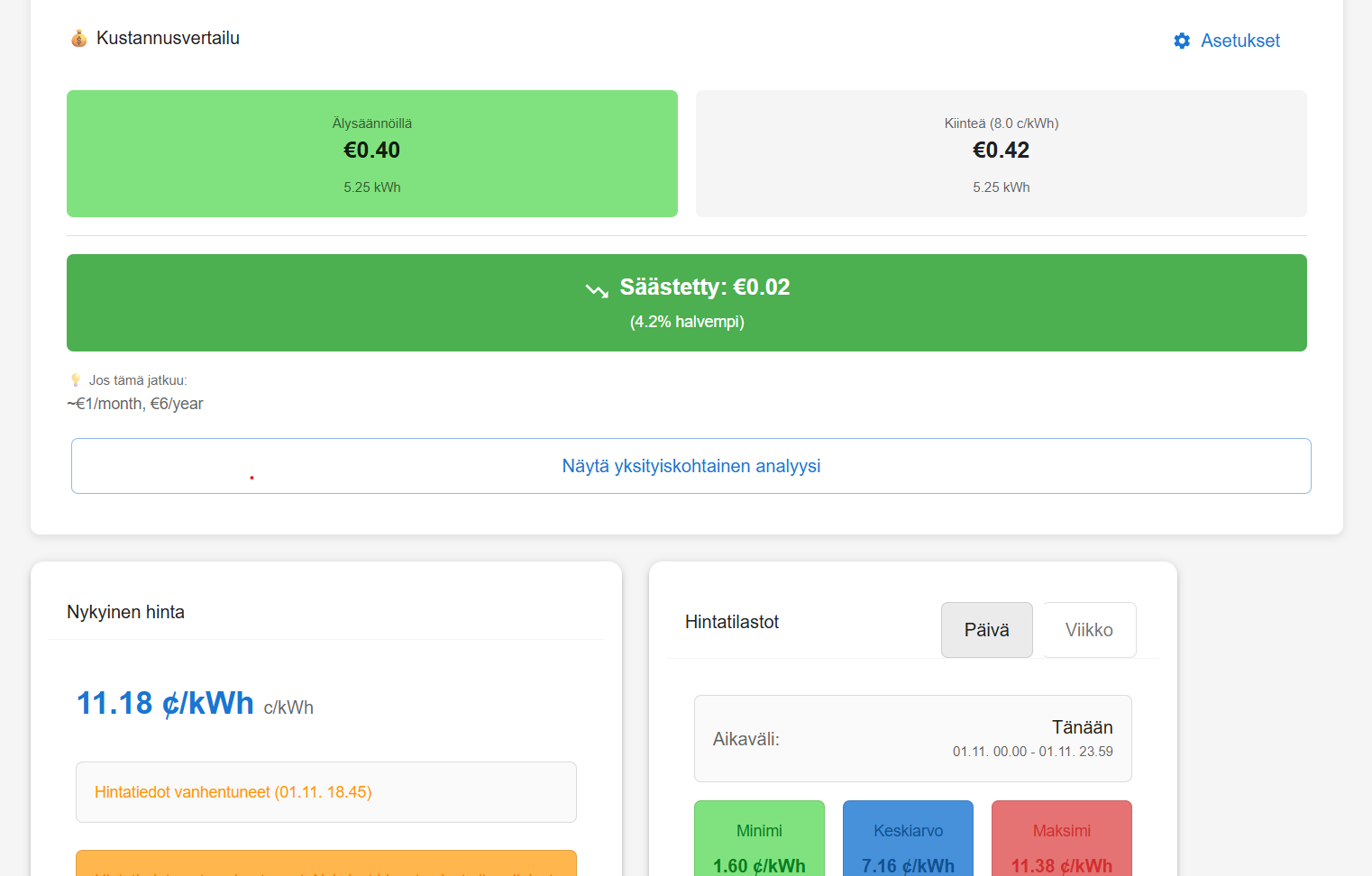
Flexible electricity contracts and automatic control
The flexible electricity contract (in Finnish joustosähkö) has spread quickly. For many it is a good middle ground between a fixed-price and a spot-price contract: you get a predictable base price, yet you can still lower your bill by influencing when you use electricity. This article explains, in plain language, what a flexible contract is and why automatic control is especially worthwhile with this contract type.
What is a flexible electricity contract?
A flexible contract (also marketed as "flex" or "hybrid") is typically a fixed-term contract with two parts:
- A fixed base price for electricity (c/kWh) plus a base fee. This brings predictability — you are not fully exposed to spot-price swings.
- A consumption effect that either lowers or raises your price depending on how you time your usage.
In other words: the base price is known in advance, but your final price depends on your own habits. With good timing you pay less than the base price alone would suggest.
What is the consumption effect?
This is the heart of a flexible contract. The consumption effect is formed by comparing the timing of your consumption to the monthly average spot price:
- If you use electricity when the spot price is below average, the consumption effect reduces your bill.
- If you use a lot of electricity during expensive hours, the consumption effect adds to the cost.
The idea is the same as with spot pricing — shift consumption to cheap hours — but the risk is smaller because the base price is fixed. The contract rewards you when your home's consumption lands on the cheap moments.
Why timing is hard to do by hand
The theory is simple, the practice is not. The spot price changes hour by hour (with some suppliers every quarter-hour), and the cheapest hours fall at a different time each day. To benefit from the consumption effect you would need to:
- check the next day's prices every day
- know which hours are cheapest
- remember to switch the water heater, heating or car charging on at exactly the right time
- do this every day, all year round
Few people manage that. And that is exactly where automation comes in.
How Optimaatti automates the benefit
Optimaatti fetches the spot prices automatically and shifts your home's large loads to the cheapest hours — without you having to do anything. In practice:
- The water heater, heating and car charging are run during cheap hours.
- Predictive control looks ahead and accounts for both price and temperature — your home stays comfortable while consumption lands at the right moments.
- Comfort is preserved: hot water is always ready and the home stays warm. Savings come from timing, not from going without.
With a flexible contract this is especially effective, because every kilowatt-hour shifted to a cheap hour improves your consumption effect relative to the month's average price.
A practical example: the water heater
The water heater is the best place to start. It uses a lot of electricity, and the timing of its heating makes little difference to you — as long as there is enough hot water.
When Optimaatti controls the water heater, it typically heats the water at night or during the cheapest hours of the day. The water is ready in the morning, but the consumption has landed on cheap moments. On a flexible contract this shows up as a smaller bill through the consumption effect — and the same benefit repeats automatically every day.
Who is flexible electricity + control for?
This combination suits you especially if you:
- want predictability (a fixed base price) but also the chance to save
- have large controllable loads: a water heater, electric heating, floor heating or an EV
- do not want to track prices or adjust anything by hand
- want to see concretely how much timing saves
Start small
You don't need the whole home at once. Start with one controllable load — for example the water heater. Add one device to Optimaatti, turn on a "cheapest hours" rule, and see the consumption-effect benefit in practice. Once the first one works, the rest are easy to add.
A flexible contract gives you a tool to save through timing. Optimaatti handles the timing for you — every day, automatically.