How Shelly smart control reduces your carbon footprint
How smarter control can reduce both your electricity bill and your home’s emissions at the same time.
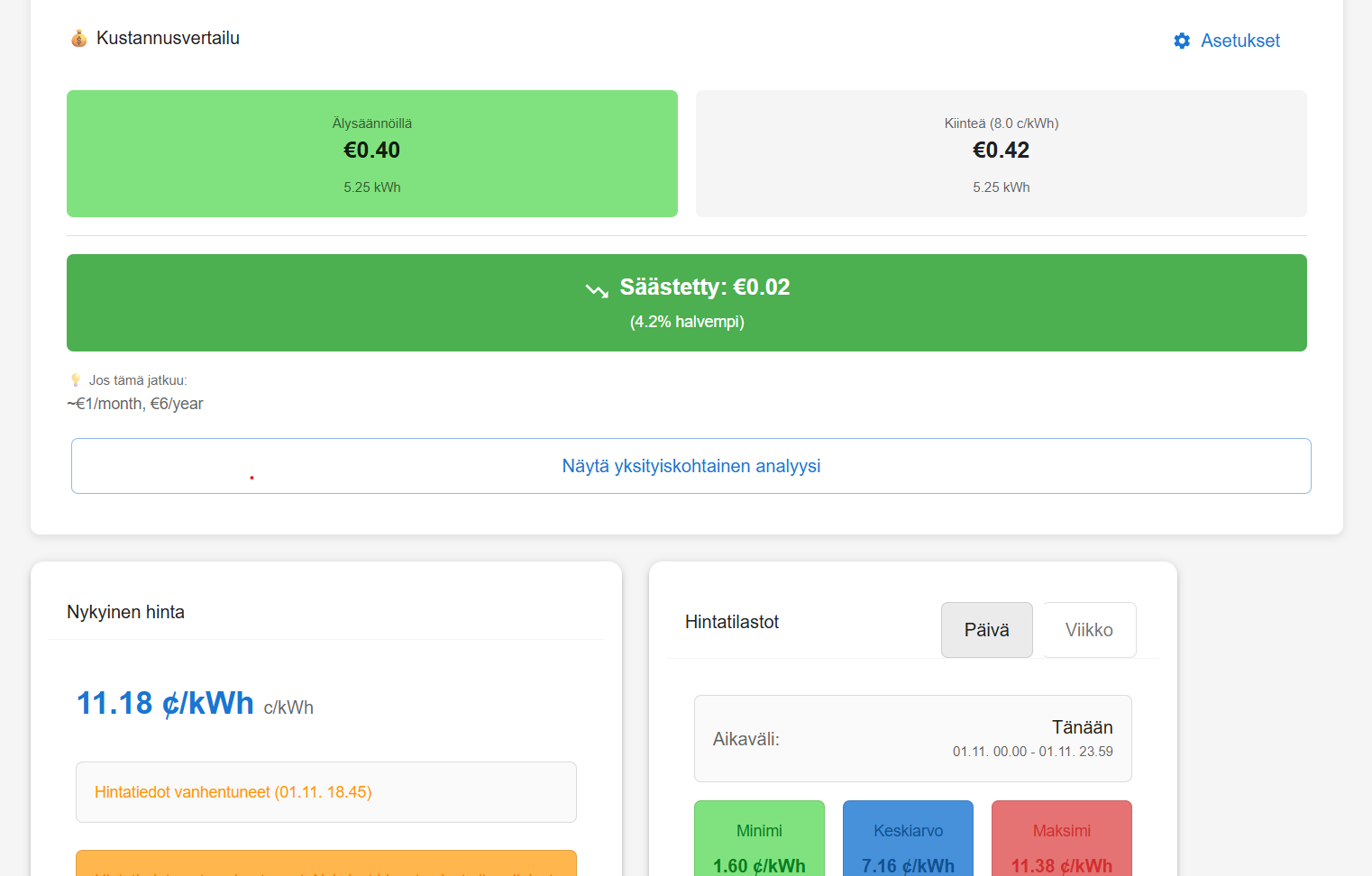
How Shelly smart control reduces your carbon footprint — with concrete examples
Demand flexibility at home — small action, big impact
A common thought is: “Why does timing matter if my total consumption is the same?”
This is where demand flexibility meets the reality of the power system:
- Not all loads can run simultaneously without relying on more expensive and dirtier generation.
- When consumption is shifted away from peaks (morning/evening spikes) to windy/solar-rich hours, the system becomes cleaner.
Shelly devices and predictive control (MPC) can automate this shift.
How do electricity emissions form?
Finland’s electricity mix is relatively clean on average, but:
- when demand is very high, more fossil generation is needed
- balancing power is often gas or coal somewhere in the Nordics/Baltics
- at those moments the marginal production is the dirtiest
In other words:
Moving one kWh away from a peak hour can reduce emissions more than saving one kWh during an average hour.
Example 1: a water heater and emission reduction
Assume:
- your water heater consumes about 3000 kWh/year
- without smart control, usage is random
- predictive control (MPC) + Shelly shifts 30–50% to cleaner and cheaper hours
If the emission difference is roughly:
- 150 g CO₂/kWh (peak) vs 50 g CO₂/kWh (windy night)
- difference 100 g CO₂ per shifted kWh
If 1500 kWh/year is shifted:
- 1500 kWh × 100 g CO₂/kWh = 150,000 g CO₂ = 150 kg CO₂ per year
That’s roughly comparable to:
- about 1000 km of driving a typical petrol car.
And that’s just one water heater.
Example 2: electric sauna and seasonal peaks
An electric sauna is a major load in many homes:
- 6–9 kW during heating
- many people heat it on Friday evenings when the grid is already stressed
Predictive control (MPC) can:
- suggest pre-heating earlier during a cleaner/cheaper hour
- limit simultaneous power with EV charging and the water heater
- keep the main fuse from overloading while smoothing peaks
Impact:
- every avoided peak reduces the need for fossil balancing power
- shifting even 200 kWh/year to cleaner hours can cut tens of kilograms of CO₂
Example 3: EV charging
An EV can easily consume:
- 2000–4000 kWh/year depending on mileage
Without smart control, charging often happens:
- right after work (evening peak)
With predictive control (MPC) + Shelly:
- charging is planned for cheap and clean night-time hours
- the car is ready when you need it
If 2500 kWh of charging is shifted with a ~100 g CO₂ benefit:
- 2500 kWh × 100 g = 250 kg CO₂ less per year
Combined with a water heater, you quickly reach hundreds of kilograms of annual CO₂ reductions for a single home.
Why automation is the key
Manually tracking prices and emissions is exhausting:
- checking data daily
- deciding the best times for each device
- constantly adjusting timers
Shelly + predictive control (MPC) can do this for you:
- fetch prices (and optionally emissions)
- optimize schedules
- execute control via Shelly without you needing to remember anything
That means:
- small emission reductions every day
- without constant effort
Summary: money and environment in one package
With smart Shelly control you:
- save money by shifting consumption to cheap hours
- reduce emissions by using electricity when it’s cleaner
- help the whole power system rely less on the dirtiest balancing generation
What feels small in one home scales massively when thousands of homes do the same.